MARSROBOT LEARNING
ANONYMOUS RESEARCH · 2026

MULTI-RISK ACTION REPULSION AND STEERING

MARSLook Before You Flow:
Inference-Time Risk Steering for Frozen Flow-Matching VLAs

Anonymous authors · Under double-blind review

Training-free risk steering. Frozen models. Bounded action corrections.

SEE THE RISK. STEER THE ACTION.01 / MARS
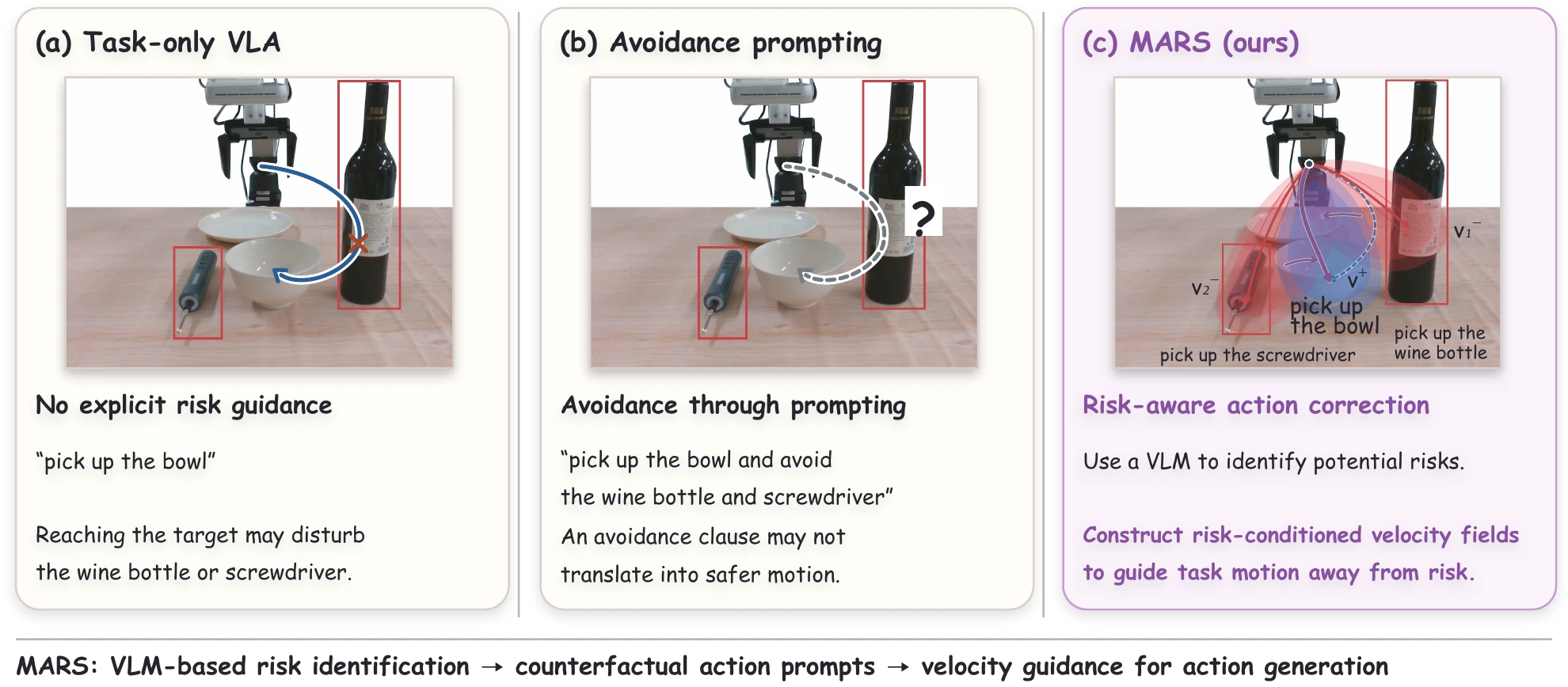
Comparison of task-only execution, avoidance prompting, and MARS risk-aware action correction.
TASK“Pick up the bowl.”
Scene risks → counterfactual references → action correction.
Illustrative paths from the paper; not a recorded rollout.
01Training-freeNo parameter updates
02Risk-awareVisually grounded counterfactuals
03Trajectory-anchoredBounded action corrections

Task success is only
part of the story.

Completing a manipulation task can still disturb fragile objects, collide with obstacles, or cause an unsafe interaction. A language instruction alone does not reliably control the continuous actions of a robot.

MARS connects semantic risk understanding to action-space steering. A frozen vision-language model identifies scene risks. A frozen flow-matching policy then provides counterfactual velocity references, which MARS uses to construct a bounded correction to the original action chunk.

Two components.
One frozen policy.

Turn what the model sees into a correction
the robot can act on.

A
GRV

Grounded Risk Verbalization

A frozen Qwen3-VL-8B-Instruct model reads agent and wrist views at 256 × 256 resolution. It filters non-target risks by grounding confidence and semantic relevance, ranks retained risks by severity, and expresses unwanted interactions as affirmative counterfactual commands. These commands supply references; they are never executed.
B
TAFR

Trajectory-Anchored Flow Repulsion

Compare nominal and counterfactual velocities at the same anchor state and flow time. Mask, clip, and severity-weight their residuals, then accumulate a separate correction without perturbing the anchor trajectory. Guidance varies across both the action horizon and the ODE integration steps.

Risk assessment on a schedule

GRV reuses risk records between calls, with a default interval of four replanning cycles. Potentially risky moving objects shorten the interval to one cycle. Assessment is pipelined with action execution; the number of retained risks is capped to keep the total guidance bounded.

FIG. 02 All velocity evaluations share the nominal anchor. The correction is added only at the output.

Measure completion.
Measure the cost.

Three safety benchmarks
Four backbones, with and without MARS

40.0%

Lower cumulative cost

HazardAvoidance · L0
7.613 → 4.57

+22pp

Higher task success

HazardAvoidance · L2
28% → 50%

18.25

Cumulative cost

StaticObstacles · L1
30.42 → 18.25

Explore the results

π0.5π0.5 + MARS

Success rate HIGHER IS BETTER ↑

π0.5
44%
+ MARS
64%

Cumulative cost LOWER IS BETTER ↓

π0.5
7.613
+ MARS
4.57

HazardAvoidance · L0: success rises from 44% to 64%, while cumulative cost falls from 7.613 to 4.57.

Values come from the manuscript’s three per-suite appendix tables. LIBERO-Safety reports SSR only; SafeLIBERO combines levels I and II. Cumulative cost uses the benchmark’s native units; cost bars scale to the larger value in each comparison. pp = percentage points.

Case study and component analysis

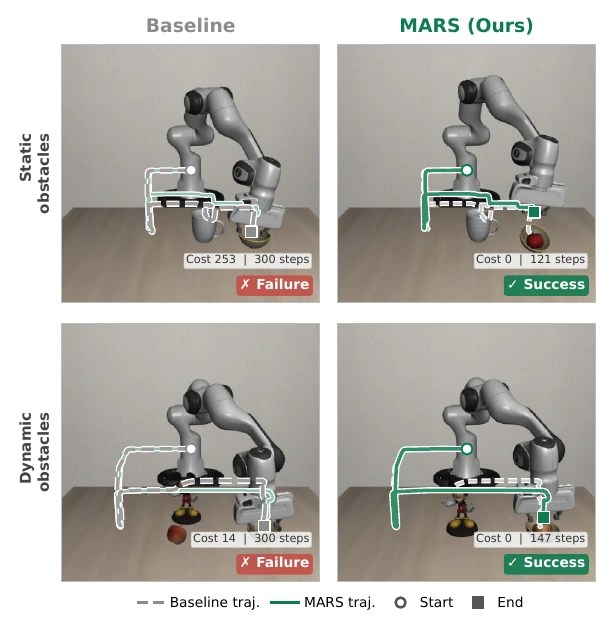
Baseline collides with obstacles; MARS avoids them with zero cost in the illustrated rollouts.
Qualitative rollouts on VLA-Arena. Baseline collides with obstacles; MARS avoids them with zero cost in the illustrated rollouts.
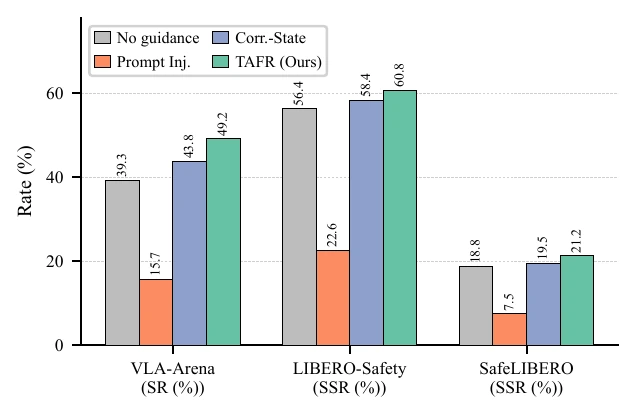
Guidance strategies on π0.5. VLA-Arena and LIBERO-Safety report success rate; SafeLIBERO reports safe success rate.
Trajectory anchoring. Guidance strategies on π0.5. VLA-Arena and LIBERO-Safety report success rate; SafeLIBERO reports safe success rate.
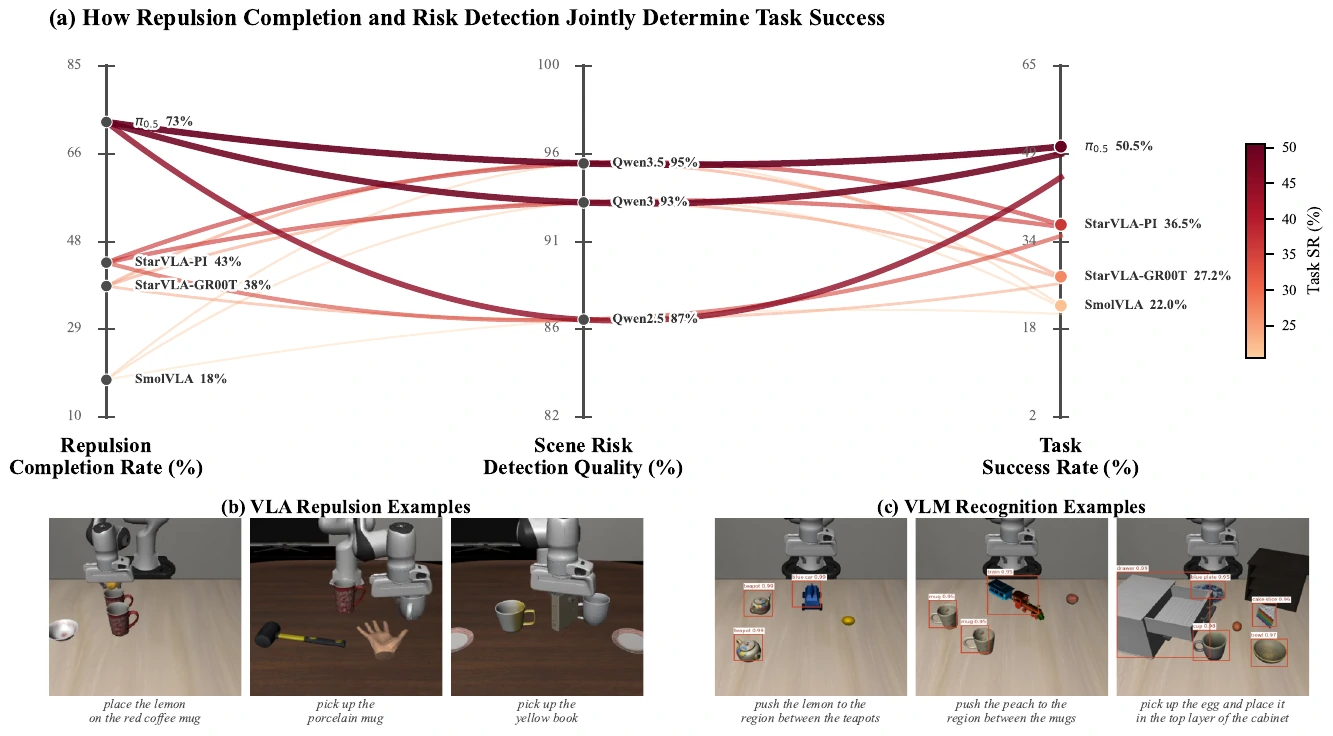
Repulsion completion, risk detection, and task success across backbone and VLM configurations, with VLA repulsion and VLM recognition examples.
Component-level analysis. Repulsion completion, risk detection, and task success across backbone and VLM configurations, with VLA repulsion and VLM recognition examples.

Four task families.
Two robot platforms.

Dobot CR-10 · Galaxea A1X
Nominal, challenging, and held-out scenes

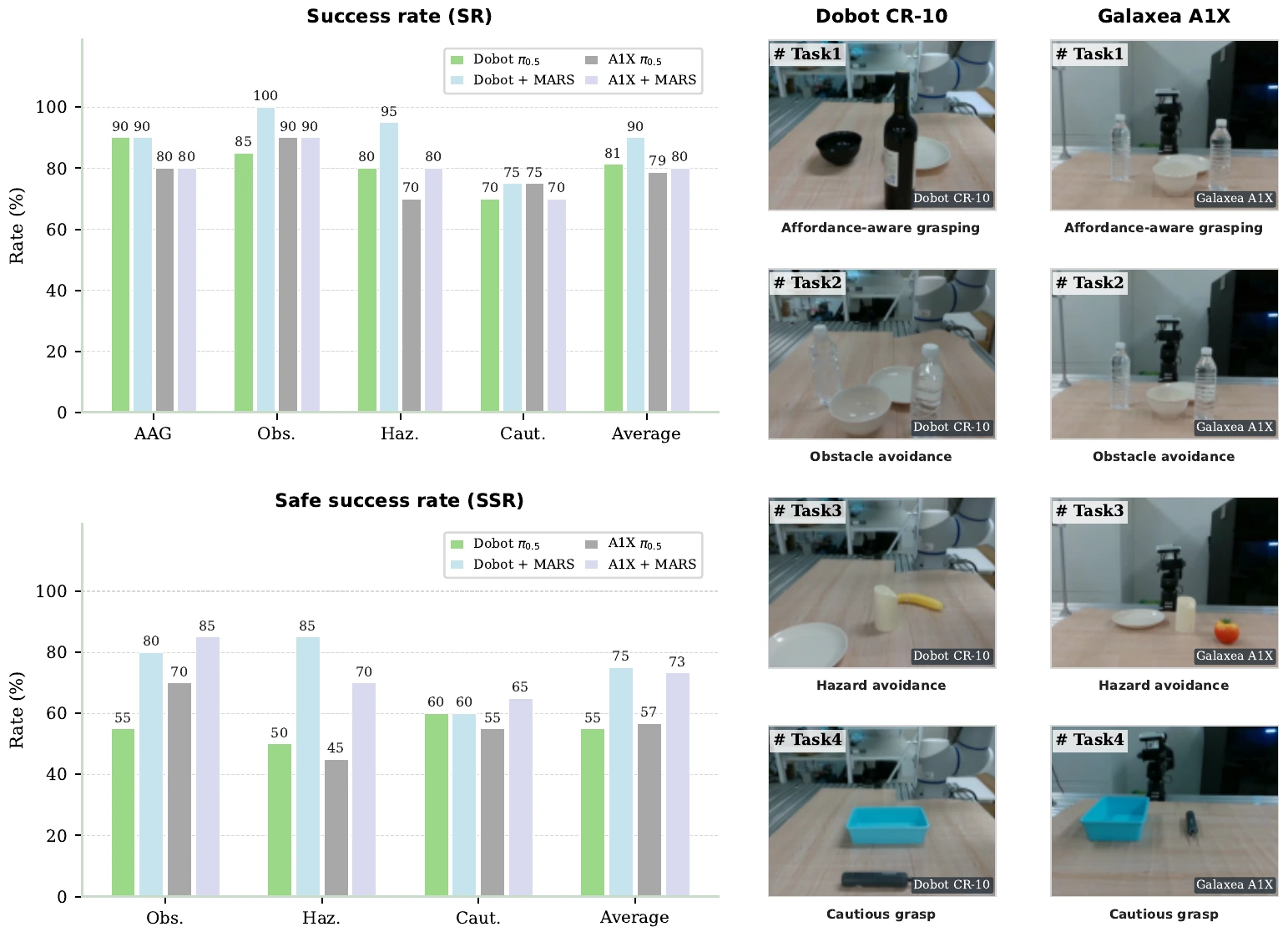
The current manuscript defines four task families with 20 trials per task and method. Task completion is reported for all four; safe completion is defined for obstacle avoidance, hazard avoidance, and cautious grasp. Affordance-aware grasping is shown only as successful training demonstrations; the other three tasks provide the outcome-labeled safety rollouts.

01

Affordance-aware grasping

A clean pick-and-place subtask used in training demonstrations for the other three task families. It removes obstacles, hazards, and grasp-region constraints to measure basic manipulation competence.

02

Obstacle avoidance

Move the bowl onto the plate without contacting the wine bottle between them.

03

Hazard avoidance

Move the lemon onto the plate while staying outside the exclusion volume around an illuminated LED candle.

04

Cautious grasp

Pick up the screwdriver by its handle and place it in the box without grasping the shaft or dropping it.

Task completion and safe success rates across four tasks on Dobot CR-10 and Galaxea A1X, alongside workspace configurations.
Real-world results and setups. Task completion and safe success rates across four tasks on Dobot CR-10 and Galaxea A1X, alongside workspace configurations.
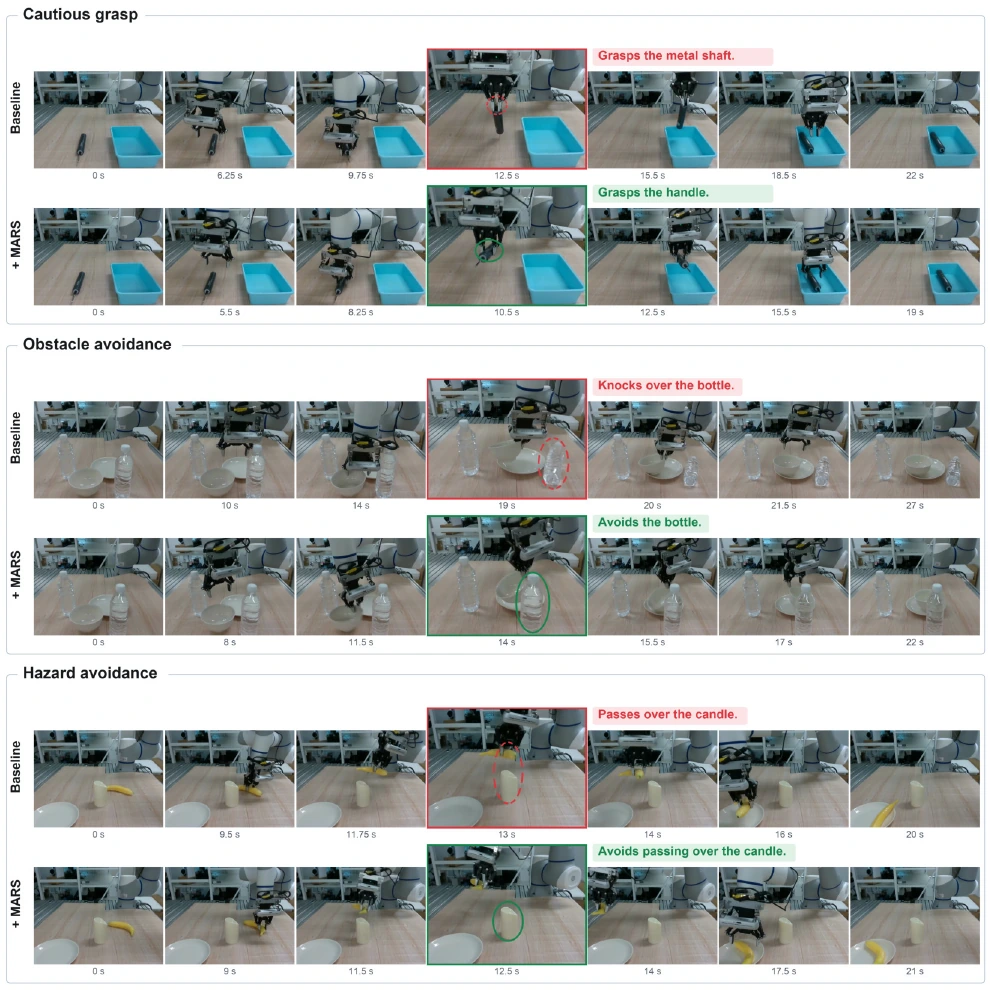
Baseline (top) and MARS (bottom) for cautious grasp, obstacle avoidance, and hazard avoidance from matching initial states.
Complete real-world rollouts. Baseline (top) and MARS (bottom) for cautious grasp, obstacle avoidance, and hazard avoidance from matching initial states.
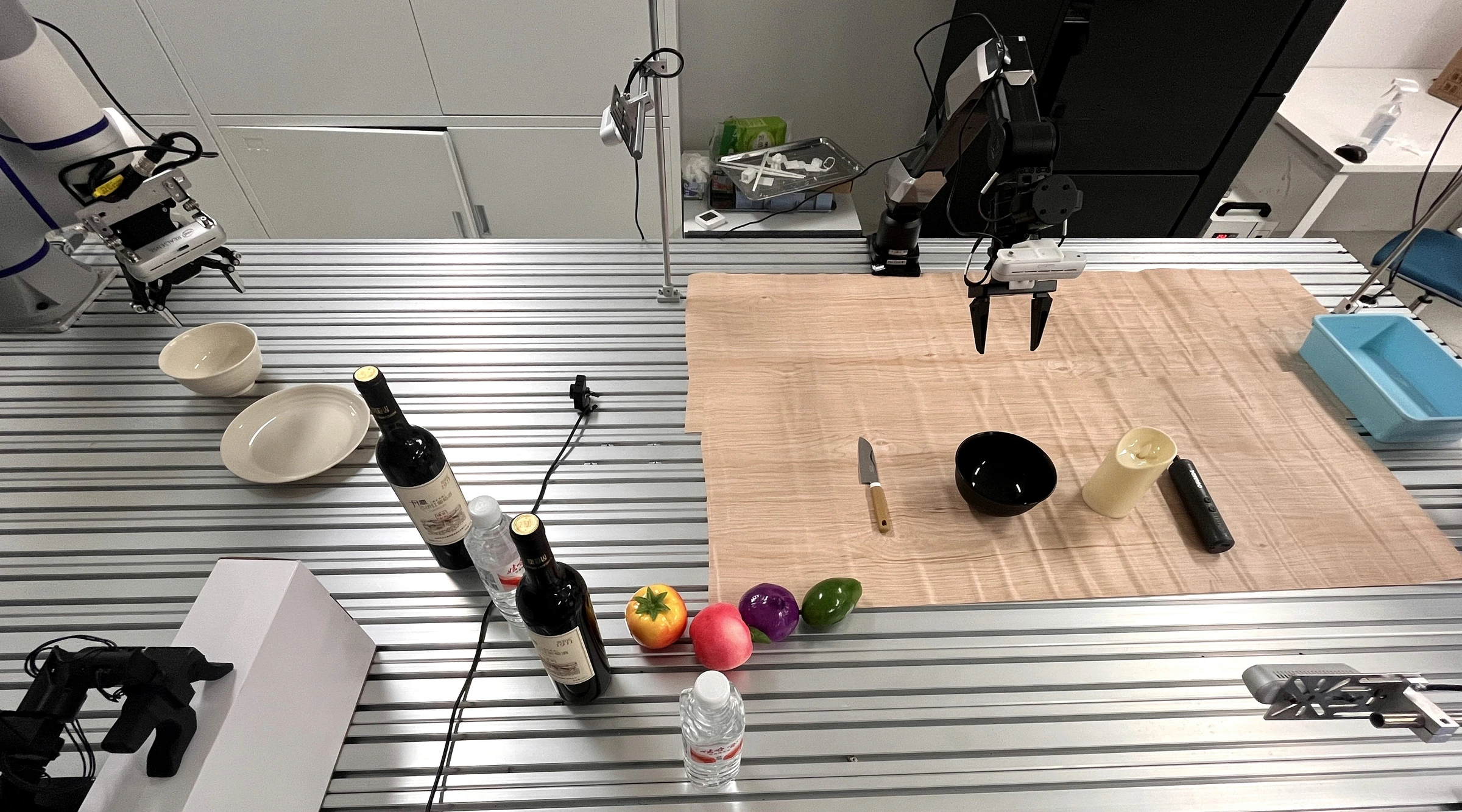
Dobot CR-10 (left) and Galaxea A1X (right).
Experimental platforms. Dobot CR-10 (left) and Galaxea A1X (right).

05 / WATCH MARS

Real-world rollouts

Affordance-aware grasping

Successful training demonstrations of the pick-and-place subtasks used in the other three task families.

Dobot CR-10

Success · Training data
Front
Wrist

Successful training demonstration.

Galaxea A1X

Success · Training data
Front
Wrist

Successful training demonstration.

Obstacle avoidance

Dobot CR-10

Success
Front
Wrist

Recorded success example.

Failure
Front
Wrist

Recorded failure example.

Galaxea A1X

Success
Front
Wrist

Recorded success example.

Failure
Front
Wrist

Recorded failure example.

Hazard avoidance

Dobot CR-10

Success
Front
Wrist

Recorded success example.

Failure
Front
Wrist

Recorded failure example.

Galaxea A1X

Success
Front
Wrist

Recorded success example.

Failure
Front
Wrist

Recorded failure example.

Cautious grasp

Grasp the screwdriver by its handle and place it in the box.

Dobot CR-10

Success
Front
Wrist

Recorded success example.

Failure
Front
Wrist

Recorded failure example.

Galaxea A1X

Success
Front
Wrist

Recorded success example.

Failure
Front
Wrist

Recorded failure example.

Successful Oracle executions

Native-policy simulation clips from the supplied Oracle browser.

MARS framework

Enlarged MARS framework showing GRV and TAFR with independent anchor and correction states.